

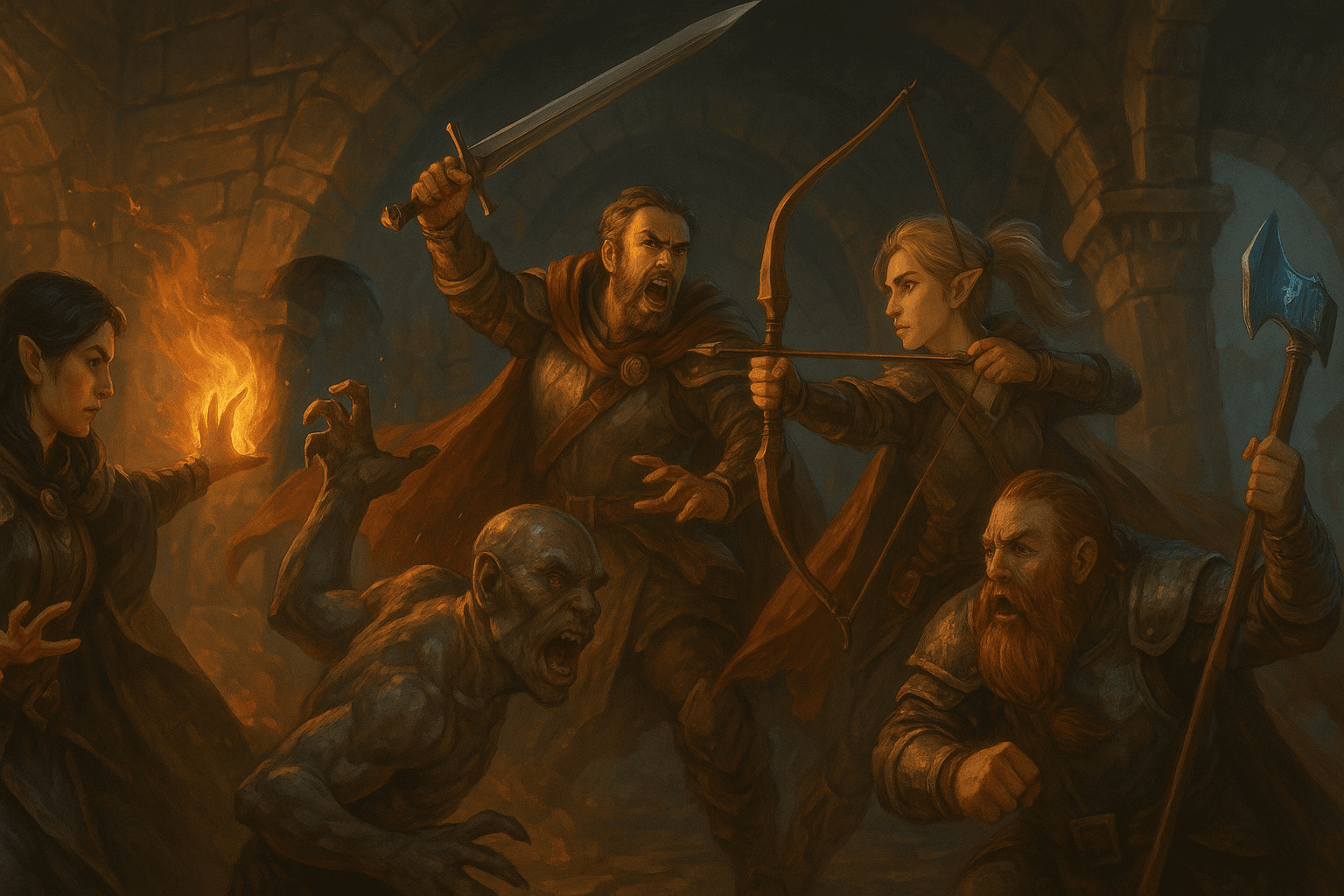
There’s a special kind of panic that hits when a manticore swoops out of the sky and the DM asks, “Roll initiative.” I’ve seen seasoned warriors freeze up, unsure of what to do when. “Can I rage now?” “When does the wizard go?” “Did I already use my reaction?”
Look, understanding turn order in D&D 5e isn’t just a formality—it’s the skeleton of every combat. Without it, you’ve got chaos. With it, you’ve got timing, strategy, and a shot at survival.
So, let me walk you through how it all works—initiative, rounds, and timing—with examples straight from my blood-soaked, flame-singed adventuring past.
What Is Initiative?
Initiative is how we determine who acts first in combat.
When the DM says, “Roll for initiative,” every player (and monster) rolls a d20 + Dexterity modifier. The highest result goes first, then the next, and so on.
Dave’s Example:
“At the Battle of Drunkard’s Hollow, I rolled a 3 for initiative. That meant the goblins got the jump—and I got a javelin in the shoulder before I could yell. Lesson learned: roll fast, react faster.”
Key Tips:
- You only roll initiative once per combat.
- Your place in the turn order stays the same until combat ends.
- Ties go to the higher Dex modifier, or the DM decides randomly.
What Is a Round?
A round in D&D 5e represents 6 seconds of real-time combat. Everyone gets one turn per round, in initiative order.
When the last person in initiative order finishes their turn, the round ends, and a new one begins at the top.
Dave’s Example:
“I once fought a medusa for six rounds. That’s just 36 seconds of in-game time—but enough to break my shield, two ribs, and my pride. Turns out, being cocky slows you down.”
What Happens on Your Turn?
On your turn, you can typically do the following:
- 1 Action
- 1 Bonus Action (if available)
- Up to your movement (e.g., 30 feet)
- 1 Free Object Interaction (draw weapon, open door, etc.)
See also: Actions, Bonus Actions, and Reactions in D&D 5e for a full breakdown of what you can do during your turn.
Your turn is your time to shine. But once it’s over, you wait for your next round—unless something triggers your reaction…
What Are Reactions and When Do They Happen?
A reaction is something you do outside your turn, triggered by a specific event.
Common triggers:
- An enemy leaves your reach → Opportunity Attack
- You’re hit by a spell → Cast Shield
- You used Ready to prep an action
You only get one reaction per round, and it resets at the start of your turn.
Dave’s Example:
“During the Siege of Rimevale, I set a Ready action to grapple the first ogre through the gate. I used my reaction to tackle him into a burning hay cart. Did I burn my pants off? Yes. Did it buy us time? Also yes.”


Turn Order Example: A 4-Player Fight
Let’s say the initiative order is:
- Rogue (18)
- Goblin (15)
- Fighter (13)
- Wizard (12)
- Cleric (9)
Each player and monster acts in that order every round. Reactions can happen between those turns, depending on what triggers them.
After the cleric finishes, the round ends. Then the rogue starts the next round at the top.
Delaying, Holding, or Interrupting
In 5e, you can’t delay your turn (like in earlier editions), but you can use the Ready action to prepare a move during someone else’s turn.
Example:
“I Ready an action to throw my axe if the mage opens the cursed chest.”
Once the chest opens, you can use your reaction to throw the axe, even though it’s not your turn.
Timing Is Strategy
The order in which things happen matters. A lot.
- Casting Bless before the barbarian attacks = Good
- Healing someone after they go down = Too late
- Using Disengage before moving = Smart
- Running away and then getting hit = Painful lesson
Understanding turn order in D&D 5e helps you make the right move at the right time—and helps your party stay alive.
Final Thoughts from Dave
Combat in D&D isn’t just about rolling high—it’s about knowing when to act, when to wait, and when to duck. The initiative tracker is your battlefield map. The round is your rhythm. Your turn is your moment.
So the next time someone yells, “Roll initiative,” take a breath, remember what you’ve learned here, and get ready to make your move.
And if all else fails? Be like me—go loud, go bold, and hope someone’s got a cleric on standby.
— Dave “The Kegslayer”, who once lost initiative and still won the tavern brawl


